by Sarah Beling
The Academy of Fortepiano Performance Festival 2026 returns to the Catskill Mountain Foundation’s Piano Performance Museum from May 30 to June 8. The event brings together students, professionals, and faculty for an immersive program of fortepiano masterclasses, historical keyboard workshops, chamber music, and performances focused on 18th- and 19th-century repertoire. Led by leading specialists in early keyboard performance practice, the festival combines education, collaboration, and concerts featuring fortepiano, harpsichord, clavichord, and chamber ensembles in a historic instrument setting.
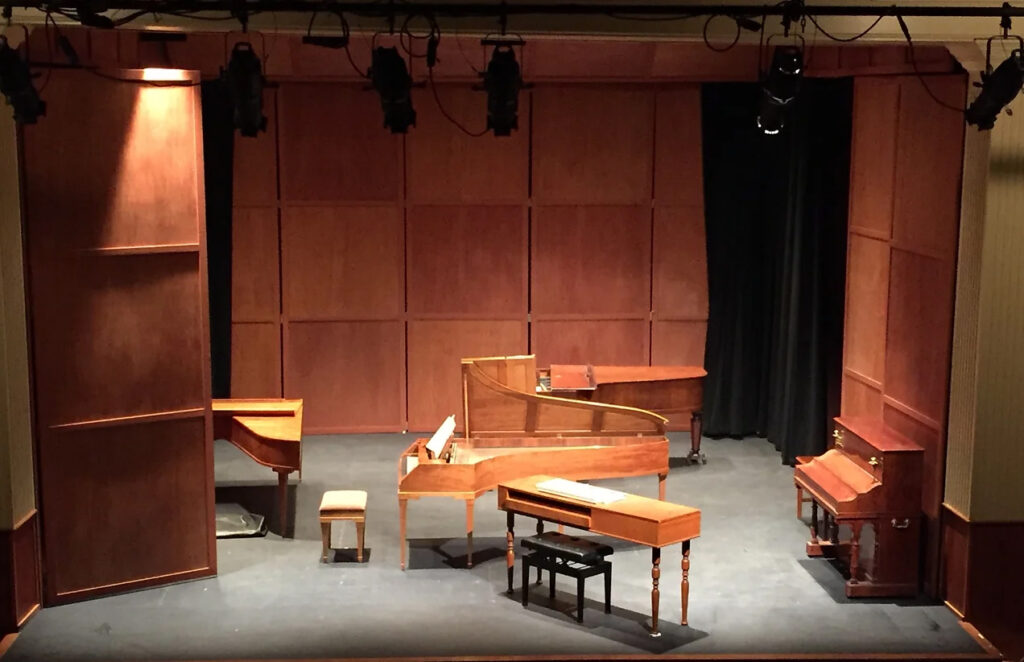
Historic pianos on stage at the Doctorow Center for the Arts in Hunter.
What to Expect at the Fortepiano Festival?
It’s time for a tune up — the Academy of Fortepiano Performance (AFP) will once again return to the Catskill Mountain Foundation’s Piano Performance Museum May 30 to June 8 for a new crop of workshops, concerts, and camaraderie.
The academy, helmed by fortepiano experts Audrey Axinn and Maria Rose, welcomes musicians ranging from advanced high school students and conservatory students to working professionals for over a week of lessons, technical workshops, lectures and performances focused around pianos from the 18th and 19th centuries. The festivities begin with a faculty concert presented by Axinn and Rose; fellow keyboardists Masayuki Maki and Andrew Willis as well as guest faculty member and baroque violinist Cynthia Roberts, who will help lead a small cohort of string players invited to attend this year’s academy.
Chamber Music Festival and Guest Faculty Highlights
“Every year we try to do something slightly different, in conjunction with our choice of guest performer,” said Rose of this year’s chamber collaboration. “Last year we invited Anders Muskens, a Canadian fortepianist living in Germany. He gave a lecture and masterclass about stage acting (theater) styles in the 18th century — a fascinating topic that is reflected in music making of the period. This year we have Cynthia Roberts, a very sought-after violinist who teaches string players about performance practice in the 17th, 18th, and 19th century — this is also very instructive for pianists and we will have several chamber music groups,” she added. “We also have more harpsichord playing this year: Masayuki Maki always teaches harpsichord and clavichord to students, but we will also have two participants who will give a harpsichord recital on June 2.”
Fortepiano Workshop, Opening Concert, and Performance Practice
The opening concert “is a way for the faculty to introduce themselves to the students who have just arrived from places all over the world,” said Rose. “Many of them don’t know us and I think it is important that we, the faculty, show who we are as artists. The rest of the week we just focus on the students and have no time to perform ourselves. We tend to play a piece that we particularly care about and sometimes give a little introduction,” she added. For faculty member Willis, the choice to play early Beethoven sonata is meant “to zero in on the transforming elements of late classicism as of around 1795,” he said, “in which an emergent Romanticism could still be fully realized through the voice of the early-period Viennese fortepiano.”
Student Experience at the Chamber Music Festival
Students not only gain the expertise of returning faculty, but also build a community of returning participants, noted Willis. “The growing community of fortepiano players is strongly bound together by shared interests, and we all continually learn from each other.” Rose agrees. “The combination of the location in Hunter, with its beautiful nature, close proximity of the venues, comfortable living spaces, and availability of interesting pianos to try out, really attracts students; especially those who are curious about history and who like to discover new perspectives,” she said, adding that program alumni have also found success outside the academy. “Several students have done well subsequently in competitions and other pursuits — one of our students in 2023 worked on repertoire with us for the Chopin Competition in Poland later that year and won first prize,” she added.
Audience Engagement and Festival Impact in the Catskills
Faculty hope that Catskills audiences will return, too. “Our students are on a professional level and deserve good audiences,” said Rose. “Hunter is far away from urban centers where our type of classical music tends to fare better, although we often hear of people who find out about us by chance and are really surprised about the high level of performances. A few weeks ago I did a short recital and we had a good audience, so it is possible!” The program has still made an impact outside of the region, added Willis. “I live in North Carolina, so I rarely see audience members from the Catskills community,” he said. “However, in at least one case, such an audience member who lives in Binghamton did come to visit in Greensboro and we shared good memories of the event he attended. He expressed interest in the possibility of returning for a future concert.”
Community and Long-Term Artistic Exchange
And as they gear up for another year at AFP, Willis and Rose are looking forward not only to seeing familiar faces, but to forging connections with new ones. “I particularly enjoy the informal interactions with students at meals or in between scheduled events, when we can share discoveries or just converse about interests,” said Willis. “I also enjoy the evening gatherings where people play whatever they are working on and share observations, appreciations, and suggestions in a relaxed setting. Returning to the Catskills I always look forward to the natural beauty of the surroundings, the refreshing summer weather, the relaxed pace of town life, and the pleasant dining options. There is a great balance between passionate artistic exploration and free time for natural growth, a very energizing synergy.”
“It is a very inspiring week and it is wonderful to see young people really excited about what they learn,” added Rose. “The irony of our work is that, by going back in time and learning about old instruments, you can learn something new,” she said. “You can follow in the footsteps of a long tradition of playing certain music in a certain way, or you can put yourself in the shoes of an 18th-century person who heard this music when it was exciting and new. The latter is what we aim for and it is the best way to stay young and engaged.”
Explore More Performance Programs
Love our events? Explore more things to do in the Catskills, including upcoming concerts and artist initiatives.